Saturday, 24 March 2012

100 Percent DEET in Canada

     On the topic of DEET(N,N-diethyl-m-toluamide) insect repellent, people have widely varying opinions of the stuff.  Some regard it as liquid gold, won't leave the house without it and slather it on any chance they can get, while others won't touch it with a ten foot pole and treat it like it's nuclear waste.  Myself, I am mostly middle ground.  I try not to use it as much as possible since it is a nasty chemical, oily on your skin and it will even dissolve some plastics. I only use it when the bugs are completely insane such as Algonquin Park in June.  Luckily at least for myself, I am not affected by mosquito bites, only the pinch when they are actually biting and them buzzing around my head is annoying.  I don’t even get red bumps or itchy afterwards, let alone get a much worse blister reaction as some people do get after mosquito bites.  In my opinion citronella and all other ‘natural’ DEET-free repellents don’t do a thing for bug repellency and are just a scam plain and simple.  Last year in Algonquin I even tried some Insect Defend brand vitamin B / thiamine  patches you apply to your skin that supposedly naturally repels insects as you excrete vitamin B through perspiration, but all it did was annoyingly make my sweat smell like Alpha Bit cereal (yes seriously), and did absolutely nothing to repel mosquitos - I was still getting eaten alive like I was a piece of steak thrown to famished sled dogs after they had run the Iditerod. So that said, I certainly don’t love DEET but I will use it on occasion. 
     When I use it I would prefer to use the strongest stuff I can get.  In preparing to go to Borneo that definitely is the case.  Unlike in Canada where mosquitos don’t transfer many diseases other than West Nile, which I personally think is much overhyped, mosquitos in the tropics have the potential to transmit a whole slew of terrible diseases, some of them being incurable and don’t even have a vaccination for.   Japanese encephalitis, malaria, yellow fever, dengue fever are among some of the mosquito borne diseases and can attack either day or night.  Not only that, jungle leeches are repelled and can be removed with DEET.  So, I would like to have the strongest DEET available for the short period of time I’m going to be in Borneo.  However, Canada decided to limit DEET products for sale to 30% DEET in 2002 due to health concerns.  DEET in very rare cases has the potential to cause seizures, and there is some evidence that long term exposure to the stuff can cause insomnia, irritability and other ill effects, but again I only use the stuff when needed and for short periods of time.
     Luckily you can still get 100% DEET products in the US.  Canada has banned the sale of higher than 30% DEET in Canada but not the importation is my understanding.  So I bought a couple bottles of the Ben’s 100 (98.1% DEET) from EBay from the US – it arrived with no problems at my house.  You can only get Ben’s 30 here in Canadian stores, Muskol as well only is 30% DEET.  Just thought I would share this little trick if you are looking for the strong stuff and have no qualms about using it... sparingly.
 
Links:


Sunday, 18 March 2012

Countdown to Borneo


So I have a flight booked to Borneo and I leave in 5 weeks, I’m going to be there for 3 weeks and I am super excited.  Adventure, anyone?  In the past many years, I have been taking local-ish vacations, usually in the backcountry somewhere in Ontario.  My kayak old buddy Steve has been teaching in Malaysia (Kuala Lumpur) and a couple months ago asked me if I was interested in joining a trip he was doing to the summit of Mount Kinabalu in Borneo.  I said sure!  Mount Kinabalu is a 13,000ft mountain in North Borneo, Boneo being a large island in the South Pacific, comprised of 3 countries – Malaysia, Indonesia and a small city-state called Brunei.
            The trip to the summit of Mount Kinabalu needs to be reserved half a year in advance due to it’s popularity.  The issue being that it takes two days to make it up and back and there is limited cabin accommodations part way up on the mountain.  From the trailhead (Timophon Gate) to the summit, the trail is actually only 8 kms long, but the problem is you have to climb 2 km in that distance.  In other words it is extremely steep.  We are also doing the Via Ferrata when up there.  A Via Feratta is a semi mountain climbing thing where you are walking along the side of a rock face attached with safety harnesses, almost semi mountain climbing.
            I am super excited about the rest of Borneo.  Not to say that the Ontario backcountry is old hat, but Borneo is a very different almost alien environment and there will be lots of new things to experience.  Other than the mount Kinabalu trip taking 2 days, my schedule is free.  Borneo is an equatorial jungle island, with native .  The wildlife is amazing with orangutans, proboscis monkey, pygmy elephants, not to mention the lesser liked creatures.  Things that nightmares are made of such as flying snakes and jungle leeches that wait on branches and leaves for you to walk by and then attach themselves to you to gorge themselves on your blood expanding 2-5 times their original size.  You have to use DEET or salt to get them off.  Nice.  Some use ‘Leech socks’, sort of gaiters that the leeches can’t bite through on your calf, so you can just flick them off.
            Other than that craziness, there’s lots of other awesomeness – amazing scuba diving in Sipadan and other areas (haven’t been diving in 6 years, but great to do it again), whitewater rafting, sea kayaking, islands to camp on, huge limestone caves to visit, strange limestone pinnacles in the central region, lots of jungle trekking, and natives to visit in their long houses, hot springs and canopy walks.  Yeah, that should keep me busy for a while.
            I just bought on Osprey Waypoint 65 travel pack online after doing much research into travel packs.  It looks pretty sweet – has a zip-off daypack to use and 65 liter capacity should be more than adequate for what I am doing.

Links:
Boreno - Wikipedia
Borneo – Lonely Planet
Mout Kinabalu – Wikipedia
Sipadan – Wikipedia

Wednesday, 15 February 2012

Rotomolded vs. Composite Kayaks

      Although there are more than two types of manufacturing processes for producing kayaks, really only two are worth talking about – composites and rolomolded polyethylene.  Composite fiberglass, Kevlar and carbon fiber kayaks are considered to be the pinnacle of kayaks to aspire to have.  After all they look nice and cost at least twice as much as their rotomolded high density polyethylene counterparts.  The rotomolded yaks look like some kid’s toy in comparison to the composite kayaks.  I want to want a composite kayak, but yet when I think about it logically, I just can’t.  The rotomolded is where it’s at, and I am actually amazed that so many composite kayaks get sold.  I guess I should back up a bit to explain what rotomold and composite is.
         Rotomold is the process by which there is a large mold cavity which is filled with some pellets of plastic – in this case high density polyethylene, a low cost tough plastic.  The mold is heated up until the pellets melt and cooled slowly while the mold is rotated – hence the name rotomold, huh?  As the mold cools, the plastic solidifies more or less on the outside of the mold in a consistent manner, the end result in this case being a kayak.  Rotomolding is good for when you can’t access the inside of a part to put another mold in for the injection mold process, which is the case for the shape of a kayak.
 
 kayak rotomold
      Composite on the other hand is a fabric – either fiberglass, Kevlar or carbon fiber, impregnated with a resin which hardens.  The fabric is mixed with the epoxy resin, then hand-laid into molds forming the outside surface.  A bag is placed over the mold under vacuum, making sure the resin is throughout the fabric and also is pressed firmly against the mold. The part against the mold is the outer surface of the kayak and is very smooth, the inside surface is rougher.  Nowadays gel coat is applied to the mold before laying in the fiber so the color becomes part of the outer surface.  The parts are taken out of the mold, and the edges are trimmed.  In the case of a kayak, the top and bottom have to be formed separately, since the mold needs to be accessible.  The two halves are glued together after hardening with a strip of molding.  The end result of a composite is a very stiff material and is lighter than rotomolding, since the material is very thin and controlled by hand laying.  

 hand laying the composite cloth in the mold

There’s really only two functional reasons why one would want a composite kayak over a rotomolded – stiffness or weight.  Composite construction is extremely stiff, though is not necessary for the function of a kayak.  By nature of it’s shape and geometry a kayak itself is very stiff compared to a canoe because the top is closed and not open.   Not only that, stiffness counts when there are high loads involved, that’s not the case in a kayak.  The weight concern is a little more practical, although not much.  A composite kayak is maybe 7 lbs lighter than a rotomolded one when you’re talking about a 50lb kayak, or about 10%-15% which is decent but not a huge advantage.  There is one other advantage, although not functional is aesthetics.  Composite kayaks look shiny and great which I think sways many people.

Rotomolded material on the other hand looks like kid’s toys probably because many kids toys themselves are rotomolded.  They’re plastic in all kinds of crazy bright colors- orange, red, yellow.  One disadvantage is the color will fade or discolor (i.e. red turn to pink) with constant exposure to UV light, although nowadays UV inhibitors in the plastic minimizes that effect.  Where HDPE shines it it’s toughness.  I throw my kayak around like a midget at a carnival and play plinko with it off the rocks on a regular basis and it keeps on ticking.  Most of the adventures and the geography of the area I paddle in, tend to have vary sharp rocks everywhere (i.e. Canadian shield) or are shallow rivers with shallow rocky bottoms (i.e. Grand River).  I also drag my kayak around on the grass and through stump covered and rocky portages.  With a rotomolded kayak, despite the scratches the hull gets, it’s not a problem.  If my kayak was a composite kayak, it would be shattered, full of holes and have patches all over it by now, not to mention I am sure a few trips would have been ruined due to a leaky kayak.  Not only that, it costs half as much as a composite kayak, as composites are very labour intensive.  All that makes a rotomold kayak the obvious choice.
The bottom of my kayak showing it's battle scars

      Like I mentioned earlier...  I want to like composite kayaks because they look real nice (esp. carbon fiber), but I just can’t in the end – the rotomold’s functionality is just so much better than a composite kayak.  When I see someone driving down the road with a composite kayak I wonder what these people actually do with their kayaks, because I’m sure they aren’t having as much fun as I am with mine.  I admit that I do refer to people with composite kayaks as posers.  Perhaps if you kayak in places with sandy beaches, not many rocks around, and deep water everywhere that’s fine, but if you really want some adventures the rotomold is the only way to go.

Monday, 6 February 2012

Indoor Kayak Storage Solution – the Harken Hoister


      So when I bought my kayak, I didn’t have a solution as to where I would store it.  I live in a small single house on the main floor without a garage or any other suitable outdoor storage space.  So I ended up just laying it down on the floor.  A 17 ft kayak is pretty large… larger than you expect when you bring it indoors.  It was lying in my bedroom, along the hallways outside of my bedroom and stretched into my kitchen.  I just accepted it for a couple weeks then it gets real annoying real fast, having to step over it all the time.  At least I could deal with it for a short period of time unlike my kayaking buddies who actually bought a house together to store their kayaks – seriously.
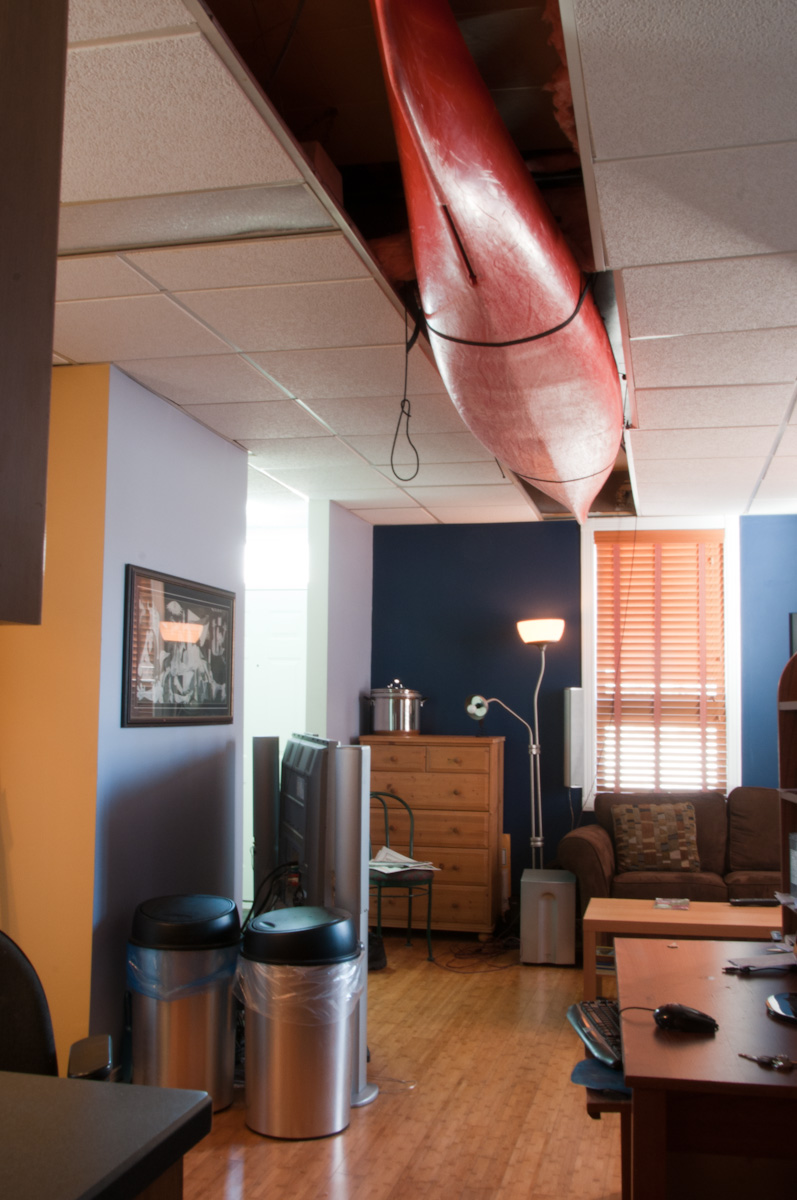
      So, I put some thought into figuring out some kind of storage solution for my kayak.  Since I have no outdoor space and I have a drop ceiling on the whole main floor, I figured it would be pretty cool to have some kind of hoist and actually store my kayak in the ceiling after taking out a few ceiling tiles.  After looking around the internet for some kind of hoist system, I found exactly what I wanted.  It’s called the Harken Hoister.  
      It’s a system of pulleys, ropes and straps that allows you to put straps around the boat with a quick connect buckle fastened to nylon straps, then pull on a rope attached to the straps through pulleys to raise the boat up.  When you let go of the rope gently, a cleat on the first pullet grabs the rope preventing it from lowering, somewhat sililar to a blind lock.  When you want to lower, you pull the rope tight and off to the side while you gently release it – this stops the cleat from digging into the rope and allows it to lower.  Naturally, this pulley system is intended for a garage so you can hoist you boat off the vehicle and store it overhead, but it works awesome inside my house.  

          I rearranged the ceiling tiles so the kayak almost fits within the 2 ft. wide section of tiles – I just had to cut the three middle ones a little smaller on one side for the boat to fit.  It sits with the bottom just slightly lower than the ceiling tiles in all it’s glory.  At first I didn’t know if I should trust the cleats or the pulleys (I did manage to screw them into some beams in the ceiling, a must)  The thought of my 55lb kayak landing square on my head while I sat at my computer doesn’t sound fun.  But it really is very secure – I’ve been using it for 3 years now.  Next house I get I’ll obviously get one with some kayak storage space in mind, but until then, this solution will certainly do.  It’s also an interesting talking point when people visit!
             
      The Harken Hoister comes in either a four point lift, which is the style I got to make sure it is as flush as is could be up to the ceiling, or a slightly lower cost two point system, it also is available in different garage (errr…. or ceiling) heights and capacities.  The one I got costs around a hundred bucks.

Monday, 23 January 2012

Kayak GPS Mount


      Kayak manufacturers seem to be pretty slow to evolve to changes.  I’m sure there’s some people diggin’ the built-in bow compasses and map to navigate because its oldschool, but I personally find a GPS indispensible and well worth the slight detraction from being one with nature while using an electronic GPS.  Especially in areas nearby like Georgian Bay where there’s literally thousands of islands and is quite simple to get lost – even with good map and compass skills.  I also like it for finding my put in and take out points and even use it for finding local pubs, places to eat or LCBOs in areas I am not familiar with.   
      That said, fixing your GPS to your kayak can be a challenging task.  Many kayaks have a built in recess to accommodate a bow compass but virtually none, even today have a mounting system for a GPS even though many people that kayak use one.
      When I first got my kayak I just used the carabiner clip to attach my GPS to the deck rigging, but it’s not accessible or visible hands-free and flops around rubbing on things on the deck.  So just a few weeks after getting my kayak I looked around for a kayak mount for my GPS.  At the time I had a Garmin Colorado.  I could not find any aftermarket mounts at all at the time, not even the suction ones.  Nowadays there are a handful of aftermarket GPS mounts but all of them are the suction cup type.   I don’t find the suction cup ‘ram mount’ type of mount ideal or acceptable – they are all way too heavy and I don’t want to rely on a suction cup to hold my GPS on my kayak either – especially on a rotomolded kayak. 
        I did find an OEM Garmin ‘marine mount’ for my Colorado GPS, which is also compatible mount with my newer Garmin GPSMAP 62s, but it seemed to have a three screw mounting pattern, which I assume is a common type of mount in the boating industry, the marine mount .  I bought one online and figured I would attempt to mount it to my kayak instead somehow when it arrived.  It turned out to be quite a simple and awesome solution for a kayak mount.

      When the marine mount arrived, I saw what it actually was – it has a round circular base plate that is intended to be fixed to a surface with three countersunk holes, and the upper part attaches to the base by a single thumb screw.  It has adjustments for yaw and pitch so it can be positioned just right for perfect accessibility and view.  So the trick was to figure out how to mount the base disc onto the kayak top surface in front of the cockpit.  I could have simply drilled three holes and mounted it with screws but I didn’t like that idea, since I didn’t want to add more screws and nuts to the underside of the cockpit to scrape my knees on, and I didn’t want to drill holes in the boat in the first place.  So I figured I would attach it with an adhesive.  After all, the disc is quite large (about 4” diameter), so even if an adhesive had moderate adhesion it should be OK.  But the top surface of my kayak is curved slightly not flat and didn’t match the disc quite well.  I ended up contouring the bottom surface of the mounting disc a little with the nose of a belt sander so the contours matched well.  I mounted the mounting disc to the top surface of the kayak with silicone caulking, after lightly sanding the kayak surface to roughen it and cleaning both surfaces with rubbing alcohol to maximize adhesion.  


      Just a note – the type of caulking that adheres best is actually the cheap kind, the one that smells like vinegar.  It also sets up the fastest.  The more expensive types I have used need 24 hours to set up and I have found they actually don’t adhere as well (but might make up for that with mold resistance).  After installing the baseplate several inches in front of the cockpit, leaving a bit of space for my skirt pull handle and using the mount, it was perfect for what I wanted.  I could even remove the mount easily, for transport or when I don’t want to use my GPS – leaving only the low profile mounting base on the kayak.
      Really, I find this a pretty awesome lightweight solution for a kayak mount for a GPS, even better than any other aftermarket ones that exist.

      I did have an  incident where the GPS popped off along with the upper mount from the lower base when I whacked it with my paddle shaft while frantically flailing around trying to paddle upstream.  I managed to find my GPS on the bottom of the icy cold fast moving stream after wading around the stream for an hour and a half.  Another time I lost my Garmin Colorado GPS, when I got caught in a strainer on Bronte Creek.  I had the upper mount tethered, but not the GPS itself since the Colorado didn't have any holes in it to be able to tether it itself and it popped out, still resting to this day at the bottom of Bronte Creek under a train bridge.  This only happened twice, but since I got my Garmin 62s have tethered the actual GPS to the rigging with a piece of paracord and a carabiner in case that ever happens again, if you are wondering what the cord is all about.
      Fortunately most Garmin GPSs have marine mounts available for them, and this can be the solution for you if you are looking for a GPS mount.  I have been using this for about 3 years now and it is perfect for what I want out of a GPS mount for my kayak.

A couple related links to kayak GPS mounts:

Sunday, 22 January 2012

Song of the Paddle – Buying a Boat, Part 2 The Beginning

So, the hype being built up and what we had in our minds the kayaks we wanted, the three of us (myself, Steve, and Peter) started looking around for shops that would carry our chosen kayaks. We all decided to get the Wilderness Systems Tempest 170 without even having had set foot into one. We checked out the local Adventure Guide store, a multi-sport all around outdoor store, but the sales guy there told us that we would have to wait 12 weeks to get one, that we should have preordered one long ago in the winter and that the people at that company take the summer off to go kayaking, so good luck getting three of them for that summer’s paddling season. Gimme a break. So we called around and heard some good things about The Complete Paddler off the QEW in Toronto, a paddling only shop. They happened to have stock of the model we wanted, and two hours later, we walked out of there, each of us having purchased a kayak and all the accessories needed to start. Mine orange, Peter’s mango (orange fading to orange) and Steve’s yellow. I nicknamed them Agent Orange, Agent Mango and Agent Banana. I also picked up the top of the line carbon fiber Ikelos paddle. Go hard or go home. Even though it’s kind of crazy to drop that much coin on a sport I had never even tried before, I knew that I would love it and spend many hours doing it. Thankfully I was right with my choices on all accounts and haven’t looked back.
It sounds a bit cliché but getting into this pastime/sport was a revelation to me, something that has brought some great happiness, excitement and joy to my life and I have spend many hours/days/weekends/weeks enjoying it ever since. It’s something much more than simply the pleasure of linking your strokes, pulling the water and gliding across it. It opens a whole new world of opportunity.
Suddenly any body of water around – reservoir, river, creek and even streams has the potential to be traveled upon for a day trip or longer adventure. Sure, in my area there’s the standard locally well known day paddling routes such as the Grand River, but anything was now fair game. Google Earth, google maps and my GPS are incredible new tools to find put-in and take-out points where previously would require a lot of scouting by car or word of mouth to find. We came up with the term ‘bushyakking’ obviously a take on bushwhacking, going down small creeks, and many times we brought saws to be able navigate through the deadfall across the creek’s path. Exciting adventures around the Ontario countryside and wilderness await. An added bonus was that these adventures would enable us to become intimate with smalltown Ontario and see the local areas in a way that simply driving through towns doesn’t let you do.


Wednesday, 18 January 2012

Song of the Paddle – Buying a Boat, Part 1 The Decision

      It’s funny that one rarely hears of anyone referring to canoes and kayaks as boats, probably because the word boat has utilitarian connotations associated with it, instead of the more soulful feelings conjured up with using the words canoe or kayak what but that’s what they are - boats. Growing up, I had not much experience with paddling. I think my parents just weren’t into it very much. I had gone hiking and backpacking a lot with my parents and Scouting/Venturers but not so much paddling, although I did feel a great lure towards it. At one point in my youth I was somewhat obsessed with canoeing, or rather the idea of it. I had watched Waterwalker, Bill Mason’s 1984 feature length documentary about him exploring the areas around Lake Superior with his canoe and it fascinated me. The beauty of the landscape and the adventure of canoeing in the wilderness captivated me as a 12 year old. But at that time, I did not do anything about my attraction towards paddling, other than taking a short canoe paddling course on the Ottawa River.
      Years went by and during my university time, I ignored my passion for the outdoors, aside from car camping trips. After I started working full time, I started to rekindle my interest for hiking and began backpacking, mostly solo in different areas in Ontario. I did this for many years, my yearly ‘summer vacation’ (more like autumn vacation) usually consisting of a week’s backpacking somewhere but not much consideration for purchasing a boat. In hindsight, this was partly because I had no place to store one, partly because I really didn’t know what boat I would want and partly because the backpacking world around me was still relatively new and there was much to be explored still in that regards.
      Then there was that fateful day in spring 2008. A bunch of people including myself were gathered at my friend Steve’s parents’ cottage on Rice Lake for the May 24 weekend for some partying. We started poring over some canoe and kayak marketing literature Steve picked up at the Adventure Show in Toronto a week or two back, at first just a curiosity, but turned into an obsession by the end of the weekend. After all, this cottage is on a lake, but there were no boats to use there, only a dilapidated aluminum rowboat hiding in the bushes so the lake being in front of our faces led to the itch for some paddling. As with many sports nowadays, the amount of choices and styles of products is simply astounding and actually quite overwhelming. I had only been in a kayak once – a day trip in a rented tandem one at Arrowhead that couldn’t track a straight line if it’s life depended on it. Despite that experience I figured I would prefer a kayak over a canoe. To me, a kayak has a more pure and intimate paddling experience much better suited for solo trips, but that’s a topic for another discussion.
      Aside from which make to get, the number of choices are incredible: hard or soft chine, Greenland or North American style, skeg or pedal rudder, whitewater, river or ocean kayak, what style hatches, rotomolded polyethylene , fiberglass or Kevlar construction, 12, 14, 15, 16, 17ft long, number of hatches??? In the end, only one really stood out as the clear choice for a rough and tumble, jack-of-all-trades multipurpose performance kayak, and that ended up being the rotomolded Wilderness Systems Tempest 170.